

What happens to business operations when there are no systems and processes in place?
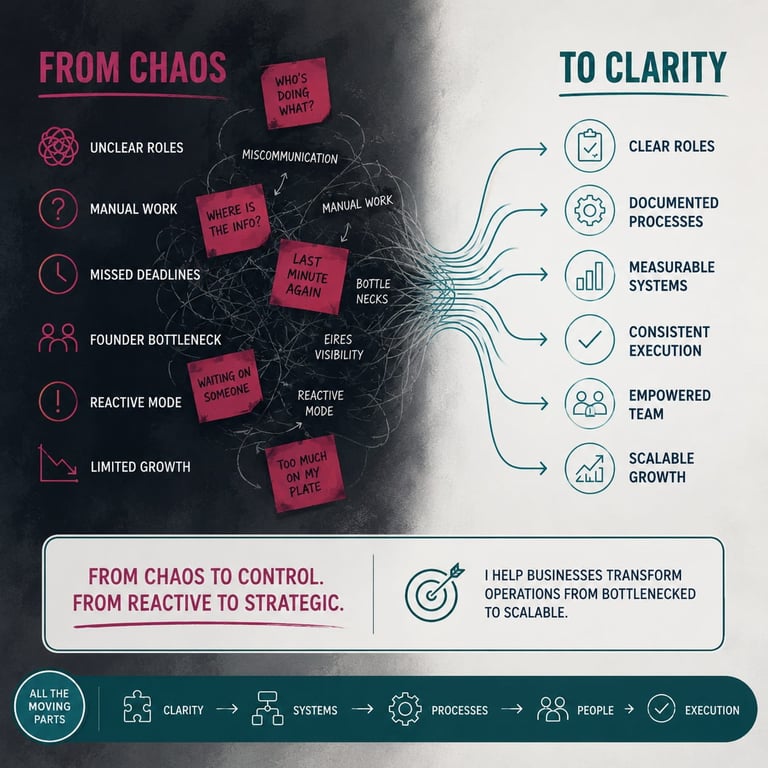
Most people assume the answer is obvious: things fall apart. Chaos. Missed deadlines. Unhappy clients.
But that's rarely what it looks like…
From the outside, the business can appear successful. Clients are being served, projects are moving, revenue is coming in, and the team is busy. Nothing looks dramatically broken. In fact, many growing businesses operate this way for years.
The real problem is what’s happening underneath the surface.
And that gap between what people expect and what actually happens is exactly why so many business owners stay stuck in it far longer than they should.
I know this because I've lived it. Not as an observer, but as the person responsible for the outcome.
How it started
I came into a business at its very beginning. Just me and the founder. No team yet, no structure, no inherited playbook. What there was: a vision, a service model, and the full weight of figuring out how to build something that actually worked.
So we built it. From the ground up. I took on operational ownership, not in title, but in reality. Marketing, sales, hiring, onboarding, training, client delivery, internal coordination, team and project management. All of it. The business grew. The team grew. Eventually we were running three service lines with close to twenty people and dozens of active client accounts.
And somewhere in the middle of all that growth, without either of us fully naming it, I became the bottleneck.
I can’t even recall how many times I could feel burnout creeping in around the edges.
What business operations actually look like without systems and processes
Here's what nobody tells you: a business without real systems and processes doesn't look broken. It looks functional. Revenue is coming in. Clients are engaged. The team is working.
And, what you can't see from the outside is what's holding it together, and that's usually one person. The person who holds all the context. The one every decision routes through before it can move forward. The one who fills the gaps that no process covers, answers the questions no documentation addresses, and keeps execution from stalling by being constantly available.
That person was me…
The team wasn't the issue. The clients weren't the issue. The structure was the issue. More precisely, the absence of one. Each function operated in its own direction. There was no operational layer connecting them, no clear ownership across the moving parts, no system that ran independently of whoever was carrying the most context at any given moment.
And I had to figure out how to fix it. Not with advice from the outside. From inside the execution, under real pressure, with real consequences if it didn't hold.
What I learned and what it means for business owners today
The first thing I understood: this isn't a mindset problem. It's a structural one. No amount of intention, effort, or capability fixes a system that doesn't exist.
The second: the solution isn't documentation. It's operational ownership. Someone has to be responsible for how all the moving parts work together. Not just planning, but ensuring execution actually happens, consistently, across every function.
The third, and the one I carry most directly into the work I do now, is this: business operations don't stabilize on their own. The founder doesn't naturally stop being the bottleneck. That shift requires deliberate structure, real accountability, and someone inside the business taking ownership of how it actually runs day to day.
I've also worked inside coaches and consultants businesses long enough to learn that what I experienced is not unique. The details change. The service lines change. The team size changes. But the pattern is the same: a business that runs well on the surface, held together underneath by a founder who can't step away without something slowing down or breaking.
That's not a growth problem. That's a systems and processes problem. That's an operational ownership problem.
And that’s the reason I now step inside businesses helping the owners build the structure, systems, and accountability their business needs to scale without them being the bottleneck.